 +38 0342 504605
  office@arpi.org.ua


Someone endlessly raves about cosmetics, clothing styles, proper nutrition, easy learning of English, all kinds of travel, receiving millions of views. Someone writes and publishes book after book about salvation from PTSD, ultra-modern management, a whole bunch of reasons why children do not listen to their parents, getting into the very heart of the market situation, fairly receiving good fees, and this is right. This is quite understandable from the point of view of a quick and desired response to a public request. But there are someone who did not think about the market situation, because they were busy with other thoughts - how to preserve the DNA of the nation. Someone found a way out for such preservation in preparing and publishing a book about the tradition of Rivne Easter egg making, and it became a bestseller. Let it be of regional importance - but a book that grateful readers in the Rivne region are buying up like hotcakes. Why?
In the early 90s, society thought that such a phenomenon as the traditional pysanka of the Rivne region had disappeared as an element of intangible cultural heritage in the last century, and with it the tradition of pysanka making.
“The communists were so afraid of that egg that they destroyed it as much as they could – literally and figuratively. While researching pysanka making, we heard many stories about how the Soviets fought against pysankas – they were boiled in public (and we know that boiling pysankas is blasphemy!), broken in whole baskets near the church, given to dogs… This is how the DNA of the nation was erased. But the sprout of that Ukrainian family tree broke through the concrete of prohibitions and stereotypes – Ukrainians, hungry for their historical culture, want to hear the voice of their ancestors!” – note heritage researchers Iryna Rachkovska and Alla Ukrainets in an interesting dialogue with them.
Why were the Soviets so afraid of pysanka? The tradition of making pysanka was family-based in nature. In pre-Soviet times, the greatest attention of families in the days before Easter was focused on these festive eggs. After all, pysanka has unique social properties - they unite, bring people together, unite.
The Soviets thought they had achieved their goal when they eliminated pysanka from the pre-holiday evenings of most families. However, with the advent of Ukraine's independence, folk craftsmen began to revive it. Polesie master pysanka makers (including men) have no rest every year a month before Easter - they are invited to give master classes to various institutions, organizations, institutions, cultural spaces and educational centers. They not only make pysanka, but also skillfully and accessiblely tell their audiences about the symbolism, colors, ornaments, regional features, etc. In total, there are no more than a hundred of these craftsmen. Among the 1.1 million inhabitants of the Rivne region, there are no more than a hundred living carriers of unique knowledge who know how to turn an egg into an Easter work of art, capable of preserving family happiness, as they believe. The tradition depends on their health and desire to share. This tradition is the story of the pysanka, that is, a story about the many small details from which the entire universe is formed, as well as simple practical advice that will make this universe accessible to anyone who wants to discover it.
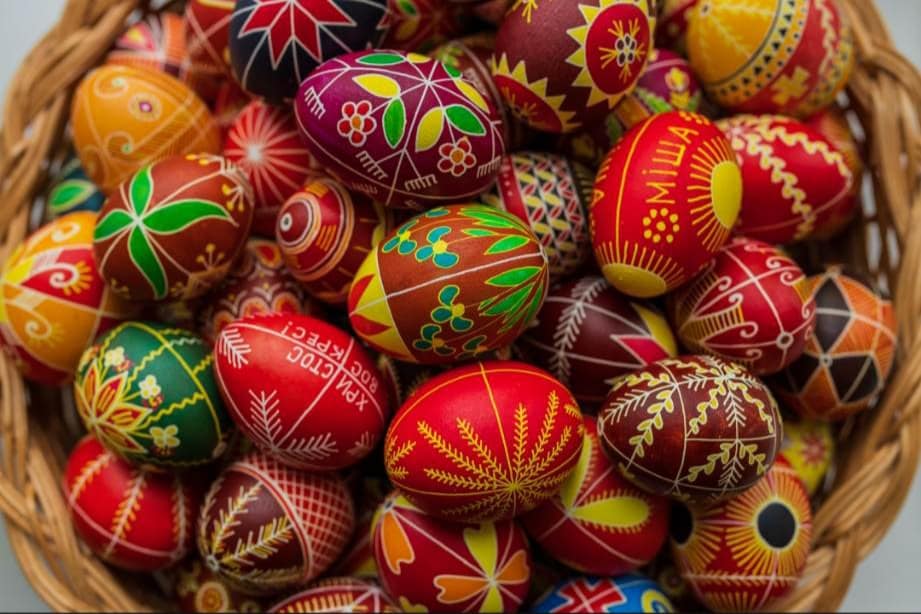
"Of the common geometric ornamental elements, we find an octagonal star ("rose") and an image of a cross... The variety of reproductions of these symbolic signs, which are often seen in other works of art, in particular in embroidered compositions, is surprising. Both signs applied to pysanka could be interpreted as symbols of the Resurrection, the victory of light over darkness, good over evil, and also as a talisman against all evil. Among other traditional geometric patterns, we find "forty wedges", "braids", "lattices", "combs", "ladders". Often they are placed on the surface arbitrarily, without additional schemes. Very interesting are mesh compositions and ornaments of oblique straight and wavy stripes that fill the entire surface of the egg. Attention is drawn to the images of infinity, spirals, the sun, the moon, and stars, which remind us of the continuous cycle in the Universe…”
“A considerable group of Easter egg ornaments common in the surveyed villages of the Radyvyliv region is related to agricultural themes: “windmills”, “grabels” (“grabelki”), “gurochki”, “spikelets”. Many elements depict plant seeds. And this is understandable. Spring is a time of hopes and expectations of peasants for the future harvest, a time of awakening of nature. That is why we find so many plant motifs in compositions: images of branches and leaves of trees (“oak leaves”, “slyvochki”), plants (“pines”, “fern”, “ficus”), flowers. Less often we encounter original anthropomorphic, ornithomorphic and zoomorphic ornaments ("men", "grasshoppers", "chickens", "crabs", "spider", "goose paws", "ram horns", "butterflies", etc.). Even if the patterns were borrowed from other things, they were not transferred to the surface of the egg without thinking. Its convex shape gave more space for imagination, improvisation."
"Among the Easter eggs made by the residents of Khotyn village, signature ones should be singled out in a special group. In addition to the traditional inscriptions "Christ is risen! Truly risen!", there are names and surnames of the Easter egg girls and the names of the boys to whom the Easter eggs were intended as a gift, inscribed in the canvas of the Easter egg patterns. And although this phenomenon is late, it is very interesting and original."
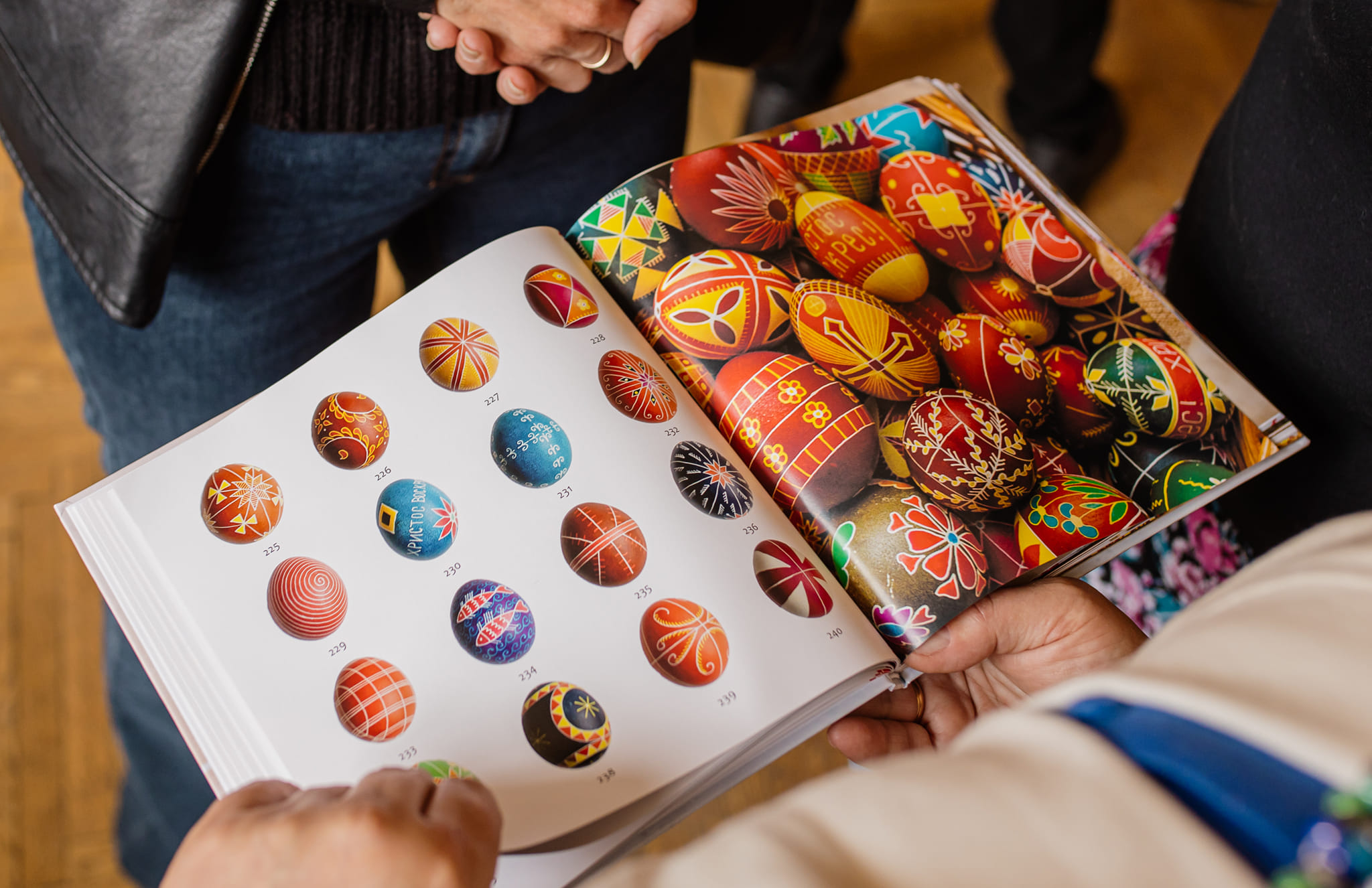
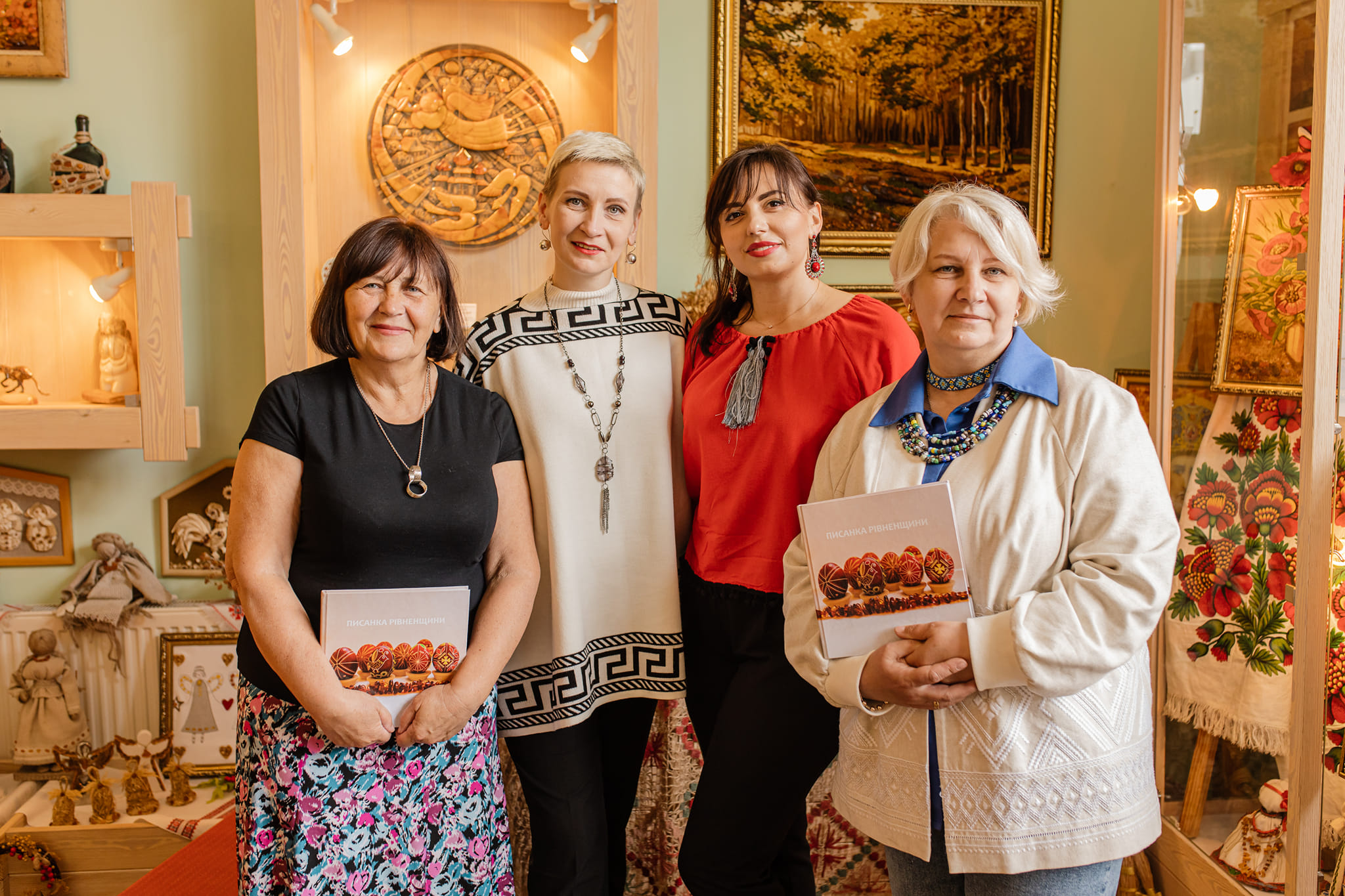
In 2023, again during the brutal Russian war on the territory of Ukraine, the tradition of Radyvylivka pysanka was recorded and successfully interpreted in the printed resource "Art-book "Pysanka of Rivne Region" (the quotes above are from there). This became possible thanks to a joint public initiative. So, back in the dawn of the 90s of the last century, local historian Nadiya Melnyk from Radyvylivka collected from old-timers all the information about the pysanka tradition of Rivne Region, formed schemes and their descriptions. Researchers Alla Ukrainets and Iryna Rachkovska conducted a scientific study and analysis of the traditional pysanka of Rivne Region. And the famous Rivne master-pysanka maker Viktoria Stepaniuk wrote off 300 pysankas according to ancient schemes and introduced regional traditions into her author's works - all of them are presented in this publication. The purpose of the book was to demonstrate to other communities of the Rivne region and regions of Ukraine the tradition preserved in the Radyvyliv region, to offer it as a resource in the study of general Ukrainian traditional culture, and to allow readers to practice making Easter eggs according to the Radyvyliv tradition.
The art book was published by the publishing house "Samit-knyga", at its own expense, thanks to cooperation with Igor Stepurin, the director of the publishing house, who is sincerely interested in educating communities about the strength and importance of local traditions. It was rather a charitable gesture on the part of the publishing house, but it turned out that the joint initiative not only created a high-quality work - it was possible to publish a book that is really in demand and sells well! Apparently, everyone has longed for a real Ukrainian cultural product, not the sharovarschina that was imposed on Ukrainians during the Soviet era.
The face of the book is Viktoriya Stepaniuk, a teacher at the Rivne Art School. Working with children and youth, ready, as she puts it, to "absorb all the information like a sponge," she is convinced that our youth will no longer be like us - they are more conscious and motivated Ukrainians, for sure! They will carry this knowledge into their own, correct world.
It is worth summarizing what this knowledge would be like in the right world. Perhaps - achieving balance, understanding the nature of folk ornament, the principles of its aesthetics, and also work capacity and patience. After all, one is constantly amazed at the patience of village craftsmen who, despite all the complexity of this work, knowing that the pysanka, this original work of art of human hands, will not live very long, every year again and again took up it in high spiritual exaltation, guided by the desire to preserve the folk tradition, to meet the greatest of Christian holidays with dignity and to realize the talent given by God.
The article was prepared within the framework of the project of the Agency for the Development of Private Initiatives "Heritage Advocates: Support and Promotion of Local Youth Initiative Groups" with co-financing from the National Endowment for Democracy (NED).

 26 Dnistrovska St., office 12